Objective: To maintain ideal thermal conditions and reduce energy consumption in a high-density data center environment.
1. The Challenge
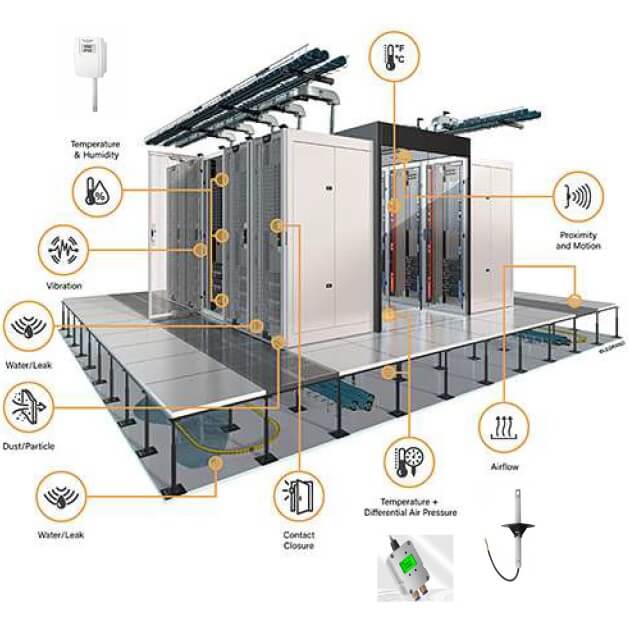
Data centers generate significant heat, requiring precise airflow management to prevent “hot spots” that can lead to equipment failure. Traditional cooling systems often operate at constant speeds, leading to energy waste during low-load periods. The facility manager needed a way to monitor real-time air velocity within the Cold Aisle Containment and CRAC (Computer Room Air Conditioning) units to automate cooling adjustments.
2. The Solution: GW1 Thermal Film Sensor Implementation
The facility integrated the GW1 EcoTech Air Velocity Transmitters (Model V13) into their Building Management System (BMS).
Precise Monitoring: Using the high-quality hot-film sensing element, the sensors provided exceptional sensitivity to detect even minute changes in air mass flow.
Strategic Placement: Probes were installed directly into the supply air ducts and under-floor plenums using the standard 150 mm probe length and mounting flange.
Environmental Resilience: With an IP65 protection rating and an operating range of -20 to +85C, the sensors remained stable despite the fluctuating temperatures within the cooling infrastructure.
3. Technical Implementation Details
| Feature | Configuration Used |
| Measuring Range | $0-15~m/s$ (selected for duct velocity) |
| Output Signal | RS485 (Modbus RTU) for seamless BMS integration |
| Power Supply | 24V AC/DC |
| Accuracy | $\pm(0.2~m/s + 3\%)$ of measured value |
4. Results and Benefits
- Energy Savings: By using the sensor’s 0.2 s response time data, the BMS could modulate fan speeds in real-time, reducing energy usage by 15%.
- Improved Reliability: The integrated temperature compensation ensured that air velocity readings remained accurate regardless of the cooling coil’s state.
- Long-term Stability: The ABS engineering plastic construction and robust design provided maintenance-free operation for over 24 months.